With hands, feet and art
NewsHow do you really learn a language? The pupils of a Basel primary school found out during the ‘Parlons Kunst’ exchange project. Together with a French partner class, they discovered that language is created above all where people meet each other.
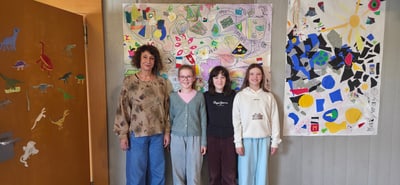
The rain poured down on the roof of the shelter at the Stade de l’Au in the Petite Camargue Alsacienne, but the children from Basel and Kembs were not deterred. While some played football, others tried to exchange their first words in the other language during a joint picnic. What began shyly at first gradually developed into friendly encounters. That is exactly what the ‘Parlons Kunst’ project is all about.
The starting point was an exchange of letters between Claudia Gradinger’s class at Brunnmatt Primary School and a French partner class taught by Odile Basler from Kembs. For months, the children wrote letters to each other in German and French. At some point, they expressed the wish to meet in person. ‘It was fun to suddenly see the girl who had written the letters,’ Clara recalls. ‘In the letter, she was very nice to me, and when I met her, she was a bit shy.’
The first meetings ultimately led to participation in ‘Parlons Kunst’. The aim of this project is to bring children from the region together through language, art and shared experiences. Instead of vocabulary tests and worksheets, the focus is on encounters. For teacher Claudia Gradinger, this is precisely the strength of such projects: ‘The advantages are certainly that the children realise that language is about relationships.’ Language is not learned in an abstract way, but is experienced in direct exchange, spontaneously, vividly and often improvised.
Engaging in conversation through art
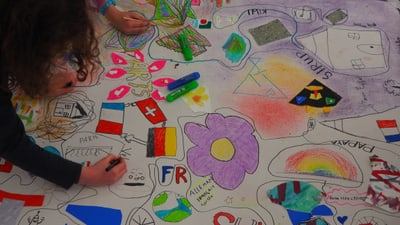
This was particularly evident during the joint visits to the Kunstmuseum Basel and the Fondation Fernet-Branca in Saint-Louis. There, the children worked in mixed groups, described artworks in German or French, tried to understand descriptions in the other language, drew pictures and created large collages. Art became a common language, even if not every word was understood. Pupil Franca describes how communication worked: ‘I tried to speak French. And if I wanted to say something and didn’t know how, I said it in German. And if the pupil from Kembs didn’t understand, I used my hands and feet.’
It was precisely these informal moments that made the exchange particularly valuable for many. New contacts were made almost incidentally while playing together, doing crafts or discussing art. The children quickly realised that communication does not have to be perfect in order to understand each other. Differences also became apparent. While some groups worked very freely and spontaneously, others created their artwork more carefully and with a plan. It was precisely these different approaches that repeatedly sparked conversations among the children, both verbally and non-verbally.
For the students, the exchange was above all motivating. French suddenly became more than just a school language, but something that could actually be used. At the same time, the children also got to know the neighbouring region better and experienced how enriching encounters across the border can be. In the end, it was not just large collages and memories of museum visits or football games in the rain that remained. It was also the experience that language becomes most alive where people really meet each other.
Text: Tamara Funck
Parlons Kunst
Several schools from Basel-Stadt and Basel-Landschaft took part in this year’s ‘Parlons Kunst’ project, which was held for the first time, including the primary schools in Brunnmatt, Wasgenring, Dreirosen, Volta, Therwil and Allschwil. The programme, which focuses on encounters and exchange, combines language learning with art and promotes cross-border exchange between school classes from the Basel region and Alsace. Teachers from Basel-Stadt and neighbouring France are working together to develop ideas for creative language exchanges and then putting these into practice with their classes. Further details regarding the next event are expected to be published in August 2026. For more information on ‘Parlons Kunst’ and other language exchanges, visit: https://www.edubs.ch/unterricht/sprachbegegnung/austausch/gruppenaustausch