Language creates identity
NewsTeaching of the Native Language and Culture (NLC) strengthens the first languages of children and young people, while conveying much more than just grammar and vocabulary. A visit to the Rittergasse primary school provides insights into the Portuguese lessons, where students discuss food advertising and experience multilingualism as part of their identity.
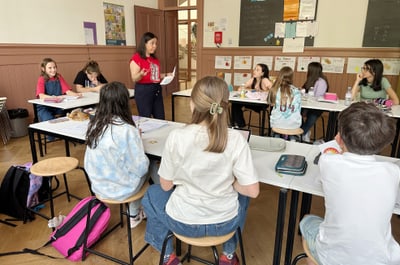
‘A romã: sabor intenso, saúde em cada grão’ is the slogan on Ana’s self-designed poster. In Portuguese, she is promoting the benefits of the pomegranate in front of her class. ‘Yes,’ she replies with conviction when asked whether her presentation might encourage others to eat more fruit. The poster is carefully designed and shows the benefits of this versatile fruit. On this Monday afternoon, the Portuguese classroom becomes a parliament: all the children present their fruit posters and defend them with arguments. Under the supervision of the parliamentary president, rules are observed, heckling is kept in check, and, in the end, the three best posters are chosen.
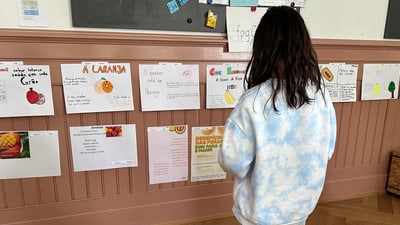
Thematic project-based learning
Currently, the Portuguese lessons at Rittergasse are focusing on nutrition, advertising promises and persuasion. The Parliament is the final topic in the food advertising unit: the students analysed advertisements and content descriptions before designing their own posters. ‘Our Portuguese lessons are more than just traditional language lessons,’ says teacher Silvia Coelho. ‘We also place great importance on the use of digital media. The children also used AI for their research on food advertising. We accompany them in this process and also assess the digital work processes together.’ The committed teacher works closely with her colleague Onélia Jorge. Together, they develop their own teaching materials for thematic project-based lessons, with individual topics being explored in depth over the course of a whole semester.
Heterogeneous groups
In Basel-Stadt, the Native Language and Culture (NLC) programme is aimed at children who speak a language other than German at home. Portuguese is one of the 39 languages on offer, in which children can deepen their knowledge of their mother tongue. The NLC programme is challenging for the teachers: it is voluntary and takes place in addition to regular lessons, the students come from different schools and have different backgrounds. ‘The biggest challenge is the different levels and backgrounds,’ says teacher Onélia Jorge. In Ettingen, for example, she teaches Portuguese, English and German at the same time, as some children hardly speak Portuguese, but have English as their mother tongue. Thanks to the specially developed teaching materials, it is easier to teach in the heterogeneous group. These teaching materials are shared on a server with all Portuguese NLC teachers across Switzerland. The 63 Portuguese NLC teachers in Switzerland are employed by the Portuguese Ministry of Foreign Affairs.
Multilingualism as a resource
For the teachers, HSK classes are not just about grammar or vocabulary, but also about identity. ‘What I miss most from Portugal is the language. Not the food, but the language,’ says Onélia Jorge. ‘Language is what creates identity. Language is my home.’ Language evokes a sense of home and is often the most direct way to express thoughts and feelings. Daniel Aeschbach, who is responsible for NLC classes at the Department of Education, also emphasises that the NLC programme is much more than a supplementary programme to school. ‘Language has a lot to do with identity,’ he says. Multilingualism is an important resource today: children learn to navigate between different linguistic and cultural worlds, to make comparisons between languages and often find it easier to learn further languages. ‘It is a great advantage to be at home in two cultures,’ says Aeschbach. The teachers are therefore proud to report on the successes of their former students, who have been accepted into higher education at the universities of Viseu and Porto in Portugal thanks to NLC classes.
Exchange and visibility
Silvia Coelho and Onélia Jorge travel together from Zurich to Basel once a week and use their shared afternoons to exchange professional ideas. ‘We are less alone when we are together,’ says Silvia Coelho about her daily work as a NLC teacher who teaches at several locations and is not part of a fixed team. She would still like to have more contact with the regular schools, however. She creates more opportunities for exchange wherever possible – for example by displaying the students’ posters in the corridors of the school building. ‘Our goal is to create a better link between the NLC and the regular school,’ says Daniel Aeschbach. To this end, further training opportunities have also been created to strengthen the cooperation between these two programmes.
If the NLC teachers were allowed to make one wish, the answer would be clear: a grade in the report. The students worked intensively and with great commitment, the teachers say. Visible recognition of their achievements would further enhance the teaching and increase motivation. The aim is not only to make the teaching itself more visible, but also the multilingualism of the children who attend it.
Text and photo: Maren Stotz
Teaching in Native Language and Culture (NLC) Portuguese
NLC classes teach children the language and culture of their home country and consolidate their skills in their first language. Silvia Coelho and Onélia Jorge are two of the three teachers who teach Portuguese to Basel students. As civil servants of the Portuguese state, they are employed by the Ministry of Foreign Affairs or the Camões Institute, respectively. The teaching staff of the coordination office for Portuguese classes in Switzerland currently comprises 63 teachers. The Portuguese classes are based on the curricula and requirements of Portugal and the HSK framework programme. Both NLC teachers have completed a teaching qualification and live in Zurich. As NLC teachers, Silvia Coelho and Onélia Jorge are not part of a teaching team. They teach at various locations in the Cantons of Basel-Stadt and Basel-Landschaft. Children attend Portuguese classes as close to their home as possible, outside of regular school hours. Attendance at NLC Portuguese classes is free of charge. As a rule, parents pay a contribution for HSK classes. Each native language is organised by a different society.
German for mothers and fathers of school children
Comprehensive German language skills help parents to better support their children in their school life. The ‘German for Mothers and Fathers of School Children’ course combines everyday German language learning with topics related to the Basel school system, the role of parents in school and other school-related topics. The courses are held at selected school locations and are aimed at non-German-speaking parents of children from kindergarten to the 6th grade.
New courses will start in August 2026 for the new school year at various locations in the city of Basel and in Riehen. The following primary schools are involved: Bläsi, Brunnmatt, Dreirosen, Erlenmatt, Gellert, Gotthelf, Isaak Iselin, Insel, Kleinhüningen, Lysbüchel, Margarethen, Neubad, Niederholz, Peter, Rittergasse, Schoren, St. Johann, Vogelsang, Volta and Wasgenring. Teachers and professionals who have contact with parents with limited German language skills can inform families about the offer.