Learn German Playfully
NewsLearning German begins with listening, understanding and participating. A visit to the ‘Stärnli’ group offers insights into early German language promotion and shows that the pre-school playgroup does much more than just support language promotion: it provides security and orientation to ensure as smooth a transition as possible to kindergarten.
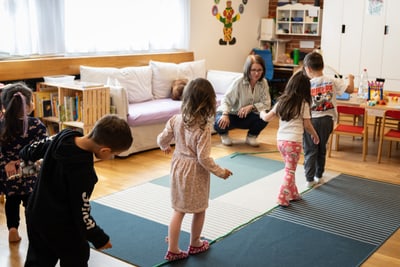
The children sing along loudly and happily. They accompany the word ‘loud’ with a gesture: they form a megaphone with their hands in front of their mouths. They sing ‘big’ with their arms stretched out and on their tiptoes, and ‘small’ in a squatting position. Many more adjectives are playfully incorporated into the songs and movements. The children’s names are called out one by one, accompanied by clapping. The carefree atmosphere is infectious, and the children seem to be at ease.
Action-based and integrated into routines
The singing circle as a welcome ritual helps the children to settle in at the ‘Stärnli’ playgroup. It is clear from the singing that many children are taking part, even those with little knowledge of German. ‘We work a lot with pictures, movement and repetition. This helps with learning German. We repeat things over and over again until they are firmly established,’ says playgroup leader Fränzi Wuest.
Songs are incorporated into the afternoon routine and again: The ‘Zvieri’ also begins with a song. After that, the fruit is counted individually. First, the group leaders count the fruit out loud, then the children are invited to join in. ‘We integrate language development into our daily routine. If a child chooses a banana, we immediately link the action to language and say: Now we’re taking a banana,’ explains the certified specialist in early language promotion. This action-based language teaching is used everywhere: when the children arrive, when they take off their jackets, when they are doing crafts at the table or playing freely. The children are engaged by combining language and play as closely as possible. ‘Language should take place where the children happen to be,’ says Fränzi Wuest.
Understanding before speaking
‘How much German the children learn during this year is as varied and individual as the children themselves,’ reports Chantal Aschwanden, the leader of the playgroup, who also works at the ‘Stärnli’. She recalls a child who hadn’t spoken all year and had just watched. On the farewell evening before starting kindergarten, the child suddenly began to speak in full sentences. ‘This shows that children absorb everything like a sponge. While some like to try things out, others are reluctant to make mistakes when speaking.’ This requires a lot of patience, something the enthusiastic playgroup leader has in abundance.
‘The first thing we notice is that the children understand,’ reports Chantal Aschwanden from her experience. ‘When we verbally announce the change from sitting at the table to sitting in a circle or vice versa, saying: 'Now we’re going to the circle,' or: 'Now it’s time for a snack,' you can see the children’s language comprehension in their reactions.’ While some children quickly find their way into the German language, others need a bit more time to say their first German words. Some like to repeat what they hear, while others only participate in the rituals and songs at first. ‘We are very happy when the children start to speak. Then we encourage them and repeat what they have said.’ This is how the vocabulary is expanded and corrective feedback is incorporated in a playful way.
Security and trust
Since the compulsory language promotion in the playgroup was increased from two to three half-days in August 2024, a lot has changed (see information box). ‘The children learn German better and speak much more after this year,’ says Fränzi Wuest. This additional half-day also helps the children integrate more quickly into the group, which has a very positive effect on the group dynamics. Often, children come to the playgroup who have hardly been separated from their parents or other primary caregivers. The major separation issues are also affecting their ability to learn German. ‘As long as the children do not feel safe, they won’t be able to learn German,’ the playgroup leader sums up. Trust is an important prerequisite for language learning – not only in the playgroup, but also for children’s future school careers.
Security and trust are also key factors for a successful start in kindergarten. Even if their German language skills are at different levels of development, the children benefit from the experience gained in the compulsory playgroup year. ‘We occasionally exchange information with the kindergarten teachers and receive positive feedback,’ says Fränzi Wuest. ‘This year is about more than just learning German. The children learn the language, but also routines, rituals and usually their first separation from their parents.’ Often, several children from the same playgroup are placed in the same kindergarten. This way, the year in the playgroup lays the foundation for a successful transition to kindergarten – linguistically, socially and emotionally.
Text: Maren Stotz, Photo: Grischa Schwank
Early German Language Promotion in the Canton of Basel-Stadt
In the ‘Stärnli’ playgroup, children who have had little or no contact with the official school language so far learn German. In order to ensure a successful start to school, children in this situation are required to attend a language promotion playgroup, day care or family day care facility in the year before they start kindergarten( in the Canton of Basel-Stadt). The effectiveness of early German language promotion has been scientifically proven: a study by the University of Basel shows that children significantly improve their German language skills during the promotion year. Many catch up on their language deficits by the time they start kindergarten. Over 80 percent of the children will then have sufficient German language skills.